Module 1 — The Treadmill You Were Born Onto
IN THIS LESSON
Your brain is not broken (it's miscalibrated).
LESSON 1.1
Your Brain Is Not Broken (It's Miscalibrated)
Module 1 · Lesson 1 of 3
Reading: 4–6 min · Video: 3–4 min · Homework: 10–15 min
📖 READING (≈1,100 words / 5 min) is, before we begin
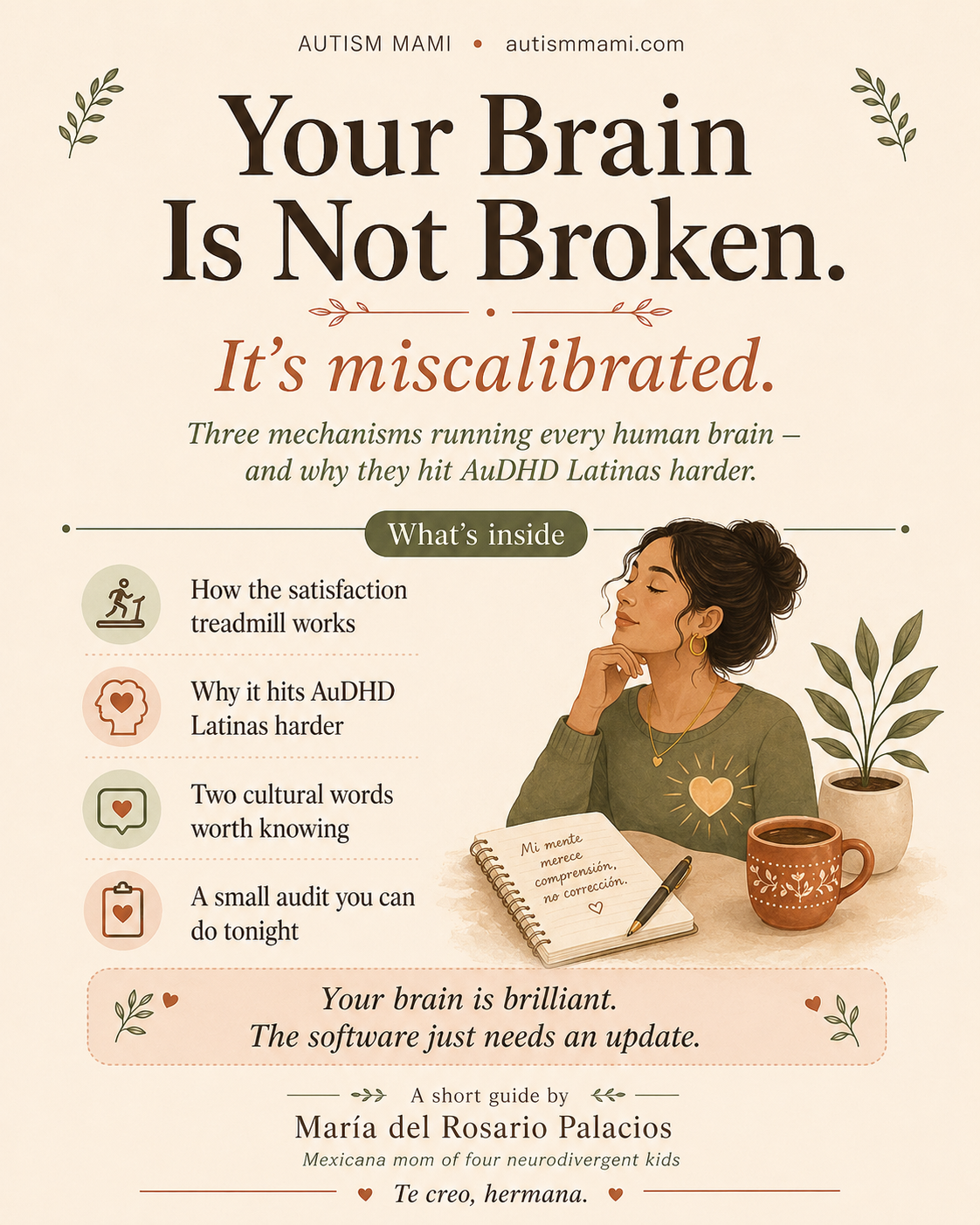
Sis, your brain is not broken. It is miscalibrated.
There is a difference, and its important we make the distinction. A broken thing has to be fixed or replaced. A miscalibrated thing just needs to be updated. The hardware is fine. The software is running on outdated predictions.
In this lesson, I am going to teach you the three mechanisms that have been quietly running your life. They are not Latina mechanisms or AuDHD mechanisms, they are part of every human brain. But once you can name them, you can stop blaming yourself for being on a treadmill that was installed before you were born.
The first mechanism: hedonic adaptation
The brain has a happiness set-point that it returns to no matter what happens to you.
Even if you win the lottery, you can go back to baseline within a year. On another end of the spectrum, if you become paralyzed in an accident, you can still go back to baseline within a year. Maybe you get the promotion you spent five years chasing, but then you go back to baseline within weeks. (Brickman, Coates & Janoff-Bulman, 1978)
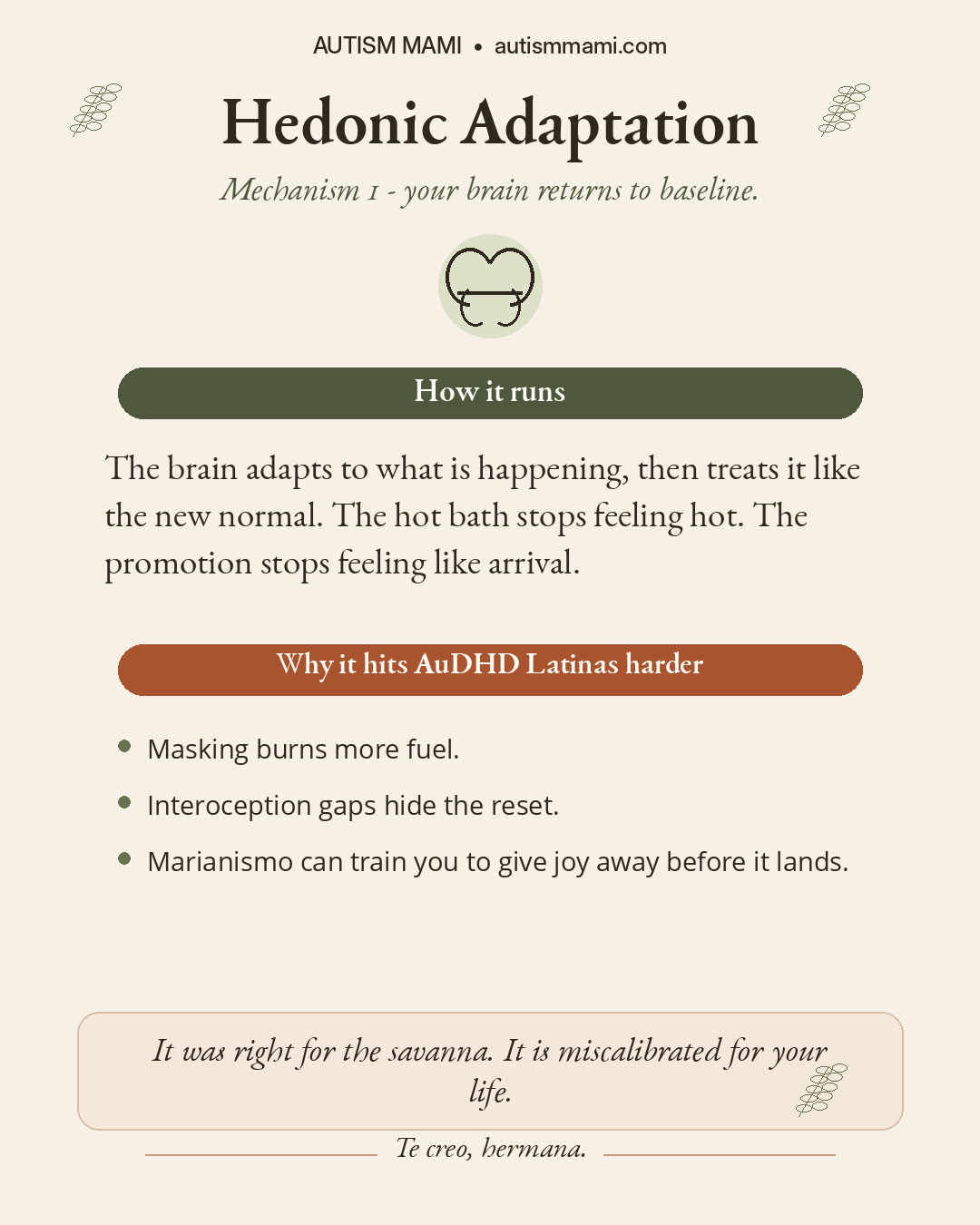
The technical term for this is hedonic adaptation. The brain calibrates whatever is currently happening as the new normal, then resets the joy-meter. It's the same mechanism that makes a hot bath stop feeling hot after three minutes, it's not that the water cooled, it's that your nervous system stopped paying attention.
This is why people can say nothing ever feels like enough for long enough. Not because you are ungrateful, or because you are broken, but because your brain was built to adapt. Adaptation kept your ancestors alive on the savanna, where staying excited about yesterday's meal would get you killed by tomorrow's predator.
It was right for the savanna, but it is miscalibrated for your life.
The second mechanism: miswanting
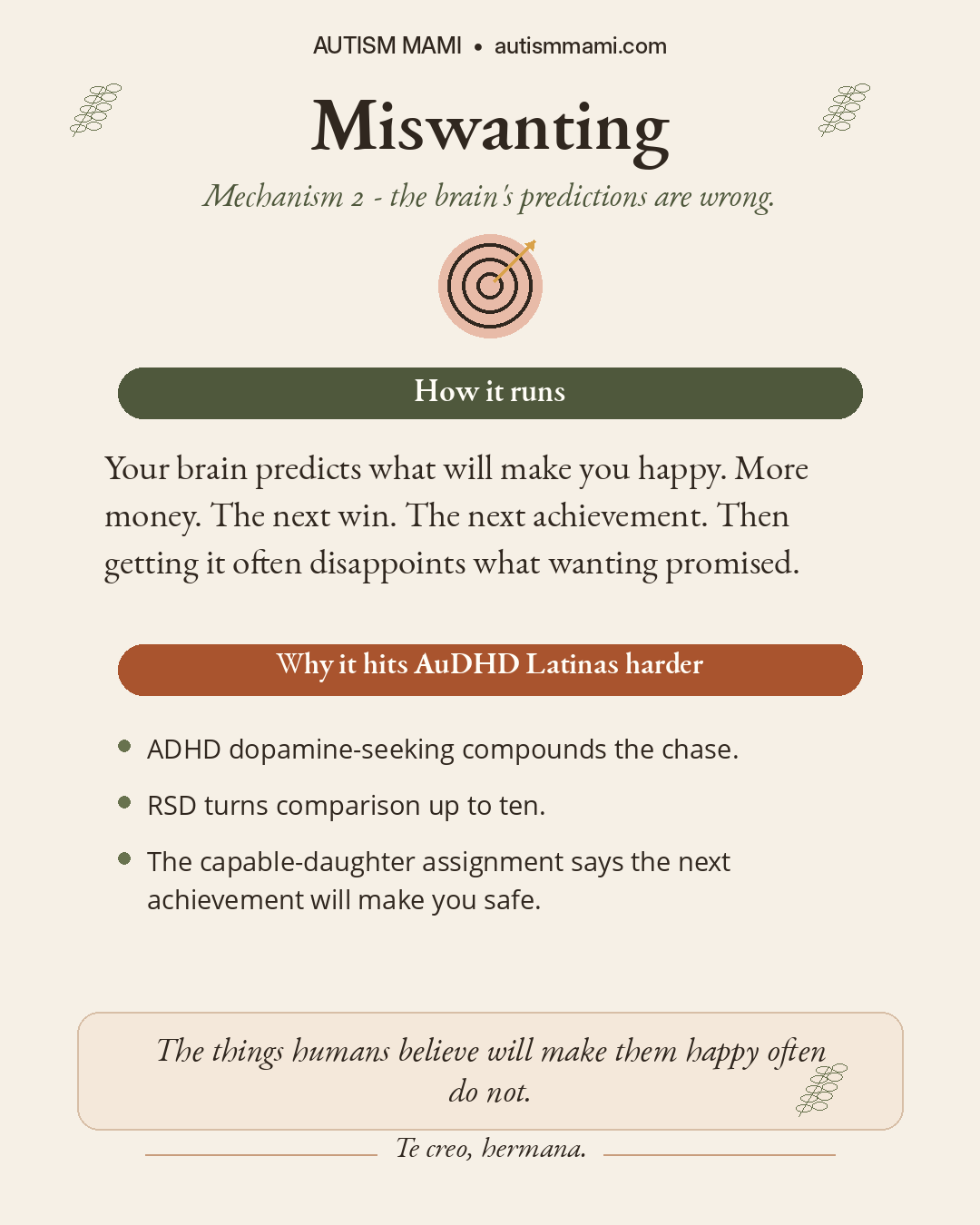
The brain is also running a prediction system about what will make you happy, but that system will often be wrong.
Psychologists Tim Wilson and Daniel Gilbert coined the term miswanting (Wilson & Gilbert, 2003) to describe a finding that has been replicated across cultures and decades:
The things humans believe will make them happy do not.
The things humans systematically deprioritize are the things that actually do.
The brain predicts: more money will make me significantly happier. Research shows the effect plateaus at a relatively modest income, because past a certain point, more money does not buy more happiness. (Killingsworth, Kahneman & Mellers, 2023)
The brain predicts: getting what I want will make me happy. Research shows wanting and having activate different neural systems. The dopamine of pursuit is not the dopamine of arrival. Getting often disappoints what wanting promised.
Sidebar — What is dopamine?
Dopamine is a specialized chemical messenger. It is technically a neurotransmitter and a hormone, which is produced in the brain that plays a critical role in how the body experiences reward, motivation, memory, and movement. Often oversimplified as the "pleasure chemical," dopamine is more accurately described as a reinforcer that teaches the brain to repeat pleasurable or necessary survival behaviors.
The brain predicts: a change in circumstances will change how I feel. Research shows adaptation returns most people to baseline within months.
The predictions will be wrong, and they keep being wrong. The brain keeps making them anyway, because it was never updated with the evidence.
The third mechanism: the satisfaction treadmill
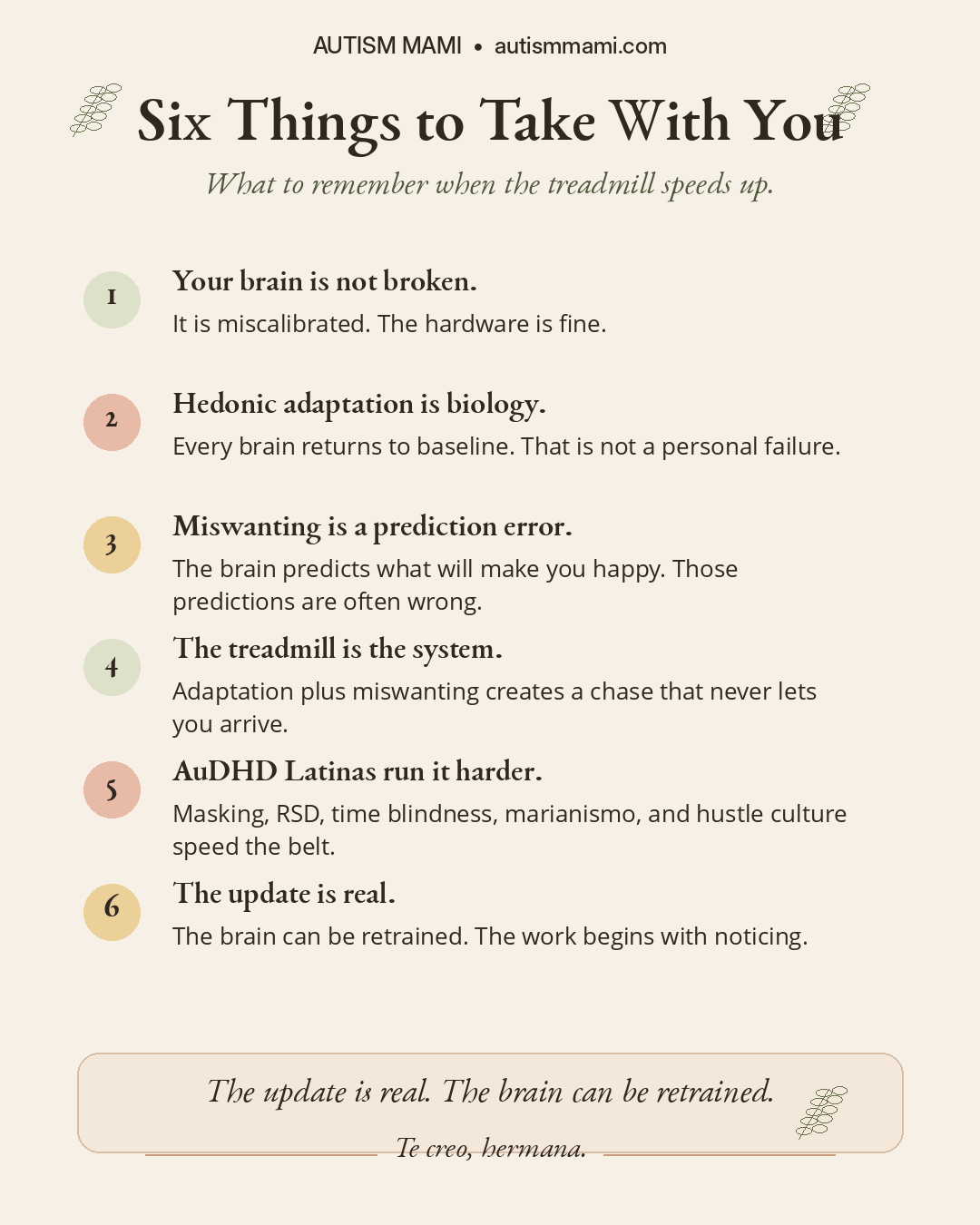
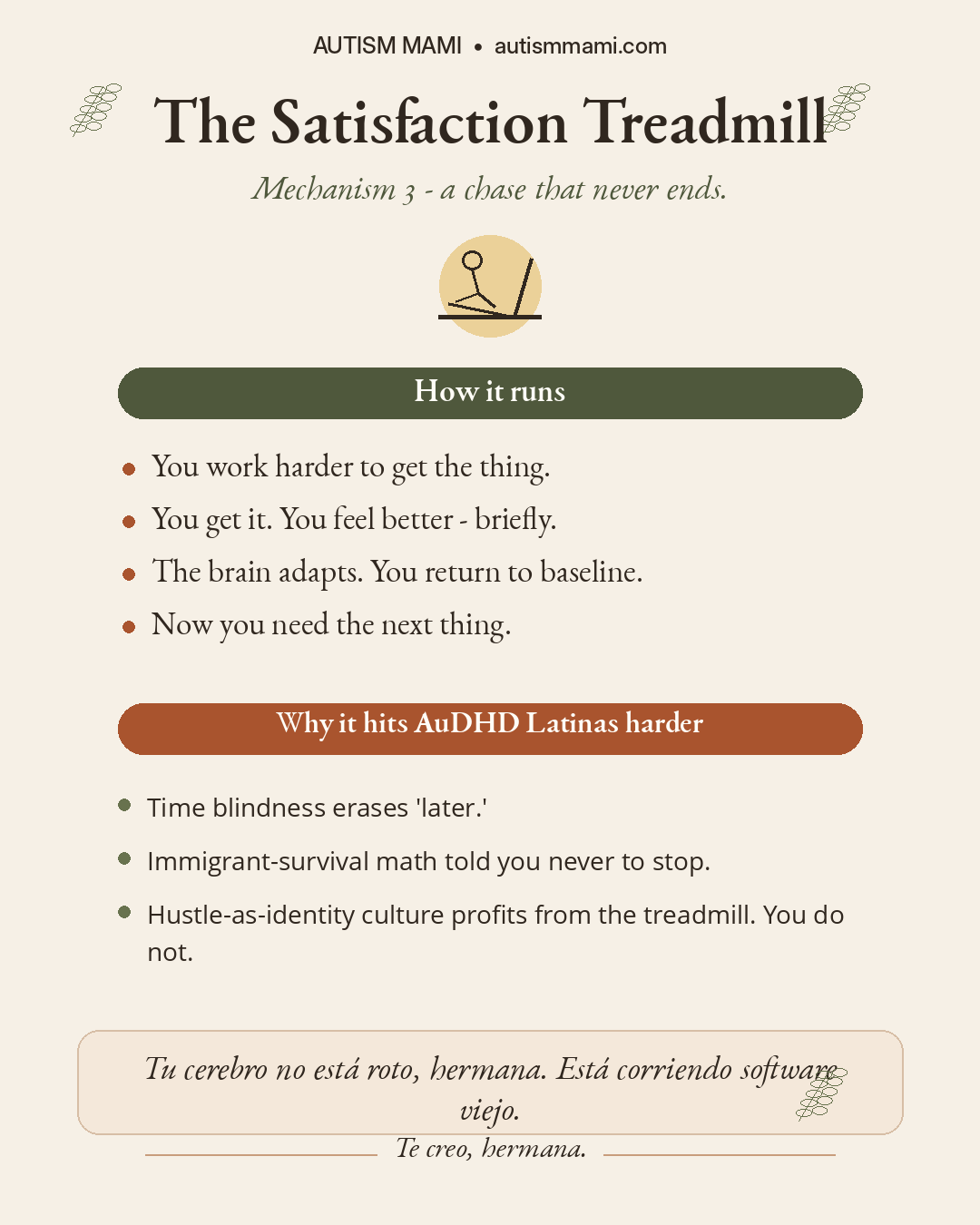
Put hedonic adaptation and miswanting together and you get what Yale psychologist Laurie Santos calls the satisfaction treadmill (Santos, 2018):
You work harder to get the thing you believe will make you happy.
You get it. You feel better, briefly.
The brain adapts. You return to baseline.
The treadmill does not stop. It speeds up.
The happiness you were running toward stays exactly the same distance ahead.
This is not a personal failure. This is a system error so universal it has been documented in every culture researchers have studied. It runs in CEOs and stay-at-home moms alike. It runs in Yale undergrads and unemployed grandfathers. It runs in you.
Why this hits AuDHD Latinas harder
Now, here is the part Santos didn't teach.
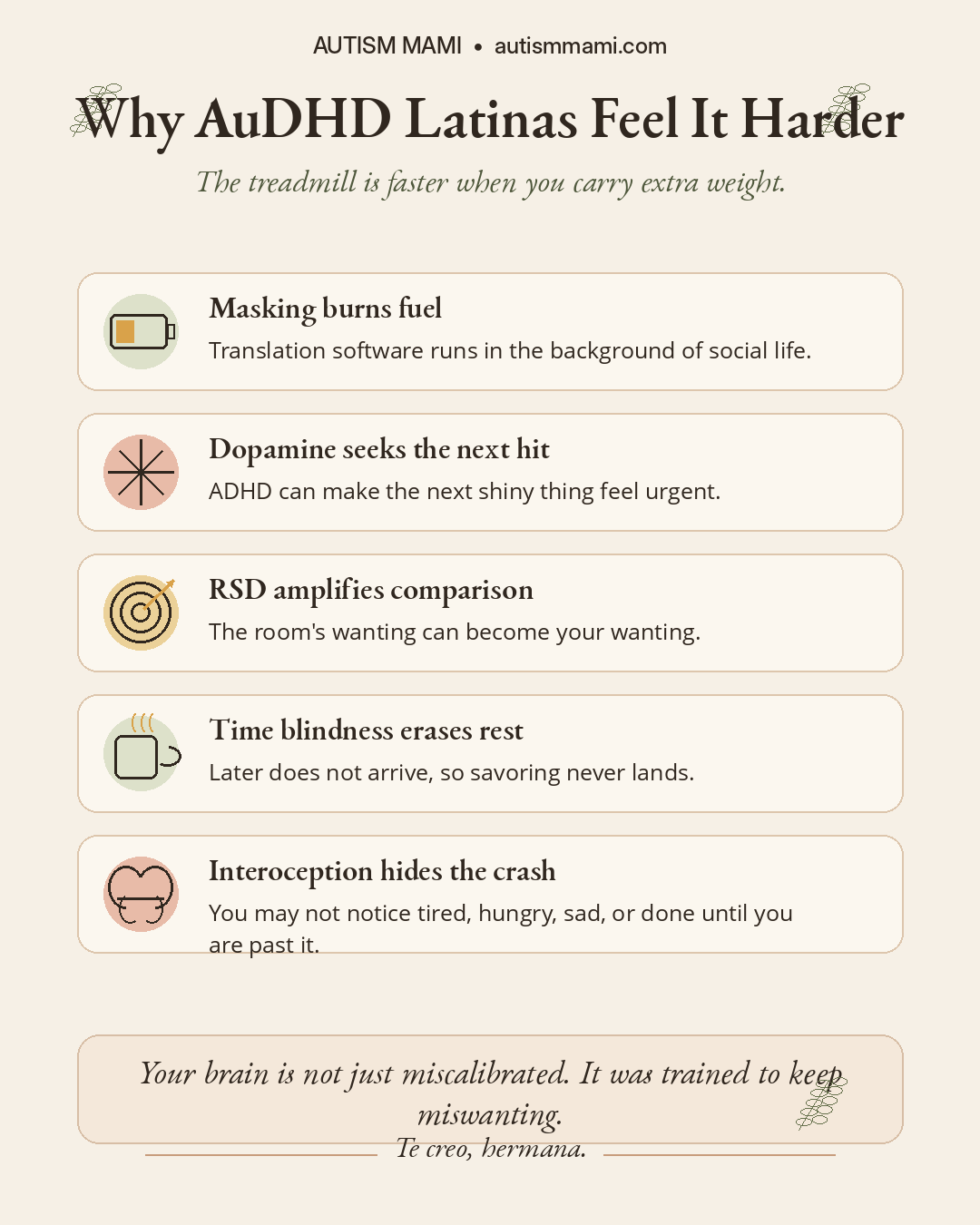
The treadmill is faster for you because your brain has been carrying extra weight on it.
Masking burns more fuel. If you are autistic, ADHD, or AuDHD, you have been performing neurotypicality, so you have been running translation software in the background of every social interaction since childhood. Your baseline energy was already negative before you started chasing anything.
ADHD dopamine-seeking compounds the cycle. ADHD brains are not just adapting to rewards, they are actively reaching for the next hit. ADHD brains are starving for excitement, so they are always chasing the next thrill. Because we get bored so fast and constantly need something shiny and new to feel 'normal,' we end up exhausting ourselves just trying to keep up.
RSD (rejection sensitive dysphoria) makes the comparison engine louder. Social comparison is already a treadmill accelerant and then RSD turns the volume to ten.
Time blindness erases "later." It makes it difficult to keep track of the pace at which you do things. I'll rest later. I'll savour later. I'll be present later. For ADHD brains, "later" is not a real time, and the savouring never lands.
Interoception gaps mean you sprint past your baseline. Both autistic and ADHD brains have well-documented interoception differences, so you do not always notice tired, hungry, sad, or done until you are past it.
And on top of that biology, you have culture challenges that may be present in your family. Marianismo told you to want harder. Immigrant-survival math told you to never stop. The capable-daughter assignment told you the next thing you achieve is the thing that finally makes you safe.
Sidebar — What is Marianismo?
In Latino culture, Marianismo is the unwritten, generations-old rule about what it means to be a "good woman." The word itself comes from the Virgin Mary (La Virgen María).It is the expectation that a woman should be endlessly self-sacrificing, nurturing, pure, and emotionally strong for everyone else. It teaches that a "good mother" and a "good wife" puts herself last — always. If you are tired, you don't complain. If you are overwhelmed, you suffer in silence and keep giving.
Your brain is not just miscalibrated. It was trained to keep miswanting.
What this means for the rest of the course
The good news (and there is good news) is that the brain can be updated. The research on this is also unambiguous. We will spend the rest of this course doing exactly that: We will be installing the practices that the evidence confirms produce sustained wellbeing for any human, and then translating each one for a NeuroSpicy Latina nervous system.
But before we install anything new, let's reflect on the system that has been running.
That is what the homework at the end of this lesson is for. We aren't trying to fix anything, or upgrade anything yet, we just want to learn more about ourselves.
You are not broken, sis. You have been running an outdated operating system on a brilliant brain in a culture that has been placed on a treadmill.
Empezamos.
✏️ OPTIONAL HOMEWORK (10–15 min)
The Three-Things Audit
Why this exercise: Before we install anything new, your brain needs to see the system it has been running. This is a noticing exercise, not a fixing exercise. Do not skip ahead to solutions.
What you'll need:
The downloadable Lesson 1.1 worksheet (in the takeaways PDF)
A pen or your Notes app
10–15 minutes uninterrupted (set a timer if your ADHD brain wants to wander)
Step 1 — List three things (3 min)
Write down three things you have spent the last decade — or the last five years — chasing. Things you genuinely believed, somewhere in your nervous system, would finally make you okay.
They can be big or small. Honest examples:
A specific number in your bank account
The promotion or title
The right partner / the right marriage
The body you're "supposed" to have
Being the favorite daughter / fixing the relationship with mamá
The diagnosis (yes, this counts — many of us miswanted this one too)
The house, the move, the city
Being seen as "the capable one" at work
No judgment. Just the truth.
Step 2 — Name what the brain predicted (4 min)
Beside each one, finish this sentence:
"My brain predicted that if I got this, I would feel ____________."
Examples:
"My brain predicted that if I got the promotion, I would feel respected."
"My brain predicted that if I lost the weight, I would feel safe in my body."
"My brain predicted that if mamá finally said she was proud, I would feel enough."
Step 3 — Mark what actually happened (4 min)
For each of the three, mark one of these:
✅ Got it. The feeling lasted.
⏳ Got it. The feeling lasted briefly, then I needed the next thing.
❌ Got it. It did not produce the feeling I predicted.
🏃 Still chasing.
Be honest. Most of your answers will be ⏳ or ❌ or 🏃. That is the whole point of this lesson.
Step 4 — Sit with it (2 min)
Do not solve. Do not journal a response. Just sit with the data for two minutes.
That is hedonic adaptation. That is miswanting. That is the satisfaction treadmill. Now you have seen it.
Optional — Share
If you are inside the Curandera community space, post one sentence to the Lesson 1.1 thread: "One thing I've been chasing is __________. Here is what my brain predicted. Here is what actually happened." You don't have to share all three. One is enough. Te creo.
-
📚 RESOURCES & FURTHER READING
Foundational research (cited in this lesson)
Brickman, Coates & Janoff-Bulman, Lottery Winners and Accident Victims: Is Happiness Relative? (1978) — the original hedonic-adaptation study. (APA PsycNet)
Wilson & Gilbert, Affective Forecasting and Miswanting (2003) — the foundational miswanting paper. (Harvard / Gilbert lab PDF)
Killingsworth, Kahneman & Mellers, Income and emotional well-being: A conflict resolved(2023) — the updated income-and-happiness data. (PNAS)
Laurie Santos, The Science of Well-Being (Yale / Coursera, 2018) — the course that named the satisfaction treadmill for a mainstream audience. (Coursera — free to audit)
If you want to go deeper
Daniel Gilbert, Stumbling on Happiness (2006) — the most readable book on miswanting. The first three chapters are enough.
Sonja Lyubomirsky, The How of Happiness (2007) — the empirical companion to Gilbert. Lyubomirsky's lab is the source of the "happiness pie" model we'll use in Module 2.
Laurie Santos, The Happiness Lab podcast — short episodes, great if you commute or do dishes. (thehappinesslab.fm)
AuDHD-specific reading (not required for this lesson, but pairs well)
Devon Price, Unmasking Autism (2022) — masking as a fuel-burner. Chapter 3 especially.
Jessica McCabe, How to ADHD — YouTube channel + book. Best plain-language explanation of dopamine-seeking and time blindness anywhere.
Hours et al. (2022), ASD and ADHD comorbidity — the research on AuDHD prevalence. (Frontiers in Psychiatry)
Latina mental health context
Lorraine Avila, The Making of Yolanda La Bruja — fiction, but the cultural texture of marianismo and "la hija buena" is exact.
Dra. Rocío Rosales Meza — Latina decolonial therapist on Instagram, @dra.rocio.rosalesmeza — her work on respectability politics pairs beautifully with this lesson.